Deeply Nourish and Warm from the Inside Out with Bone Broth
Learn: what makes bone broth fundamentally healing in nature, how to prepare your own broth, & how to manage your broth supply and build it into your routine
Written by: Rachel McGourney
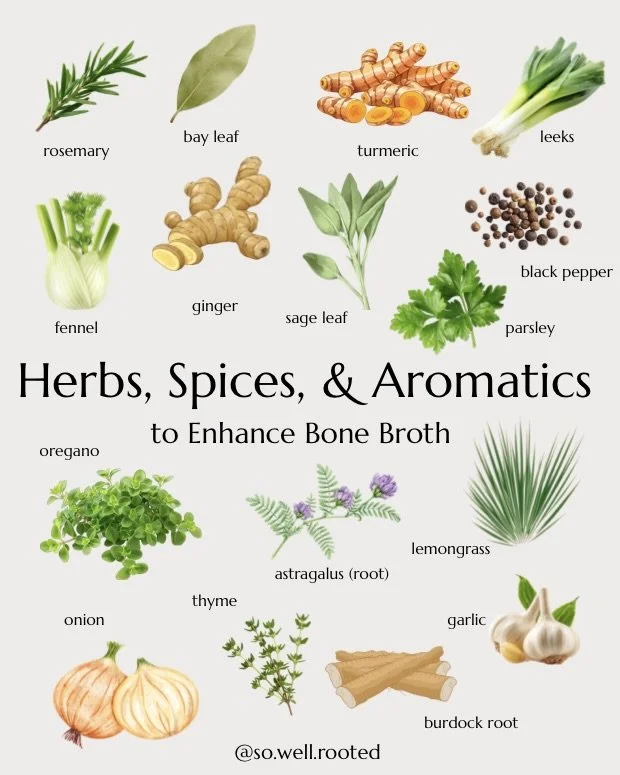
Bone broth is an extremely nutritive preparation of a combination of animal bones, herbs, aromatics, mushrooms, and seaweeds to not only nourish at the time of consumption, but also enhance the bioavailability of nutrients in others foods you eat! Full of amino acids, collagen, glycine, and hyaluronic acid, this warming kitchen staple is essential for vitality.
Historical Importance of Broth-Based Cooking
The presence of bone broth appears across cultures all over the world for thousands of years. Chinese, Greek, Italian, Middle Eastern, and African cultures have all relied heavily on broth based cooking to provide essential nutrients, use up all animal/fish parts, and share meals with others. We also see that the kinds of animal cuts (pork, beef, chicken, sheep, goat, rabbit, deer, bison, elk, etc.) that each culture tends toward depends heavily on geographical location, animal populations, among other factors. It would be impossible to describe the intracacies of bone broth making throughout history in all of these cultures, however even an immature understanding of the prevalence of broth making throughout the world over time is a testament to the health benefits experienced when made a core part of nutrition.
In some Asian cultures for instance, broth has historically been recommended to pregnant women and during postpartum. This is in part because TCM recognizes that broth made with bones is both Blood building and Yin nourishing; two of the most needed energies during pregnancy and post-childbirth.
The Nutritional Powerhouse of a Quality Broth
Blood Sugar Balancing — Bone broth contains almost no carbohydrates and is high in amino acids - the building blocks of protein - which means it’s not going to rapidly spike insulin. This is a satiating, nutritionally dense way to manage blood sugar (glucose) levels, postively impact hormones, care for your cognitive health, and keep cravings within a manageable threshold.
High Protein delivering Glucosamine and Chondroitin — These are essential building blocks to help reduce the friction and shock of bones gliding past one another. These are released from animal cartilage during the long, slow simmering of the broth.
Collagen / Gelatin Rich — Also directly from bones comes collagen and, depending on preparation method, gelatin. Gelatin aids in repairing joints and restores gut health while collagen supports healthy hair, skin and nails.
High Protein delivering Glycine / Glutamine Rich — Glycine can be considered an anti-inflammatory nutrient. It’s functions are numerous and include playing an essential role in collagen production, supporting muscle growth, repair, and recovery, acting as an inhibitor neurotransmitter which produces a calming effect, helps produce serotonin and dopamine, a vital component of making glutathione (an antioxidant), improves insulin sensitivity and supports the liver. Glutamine is especially impactful for digestive and immune health. White blood cells in your immune system to protect you from pathogens, keeping you healthy. Many of those white blood cells are found in the intestinal wall which becomes strengthened by glutamine. In other words, the integrity of your gut lining is positively impacted by glutamine.
Hyaluronic Acid Rich — One-third of the water in the human body is found outside of cells in a space called the interstitium. The interstitium exists around cells, tissues, and organs throughout the body and contains hyaluronic acid. We naturally produce HA, and ingesting foods rich in HA is beneficial in a number of ways because of its incredible ability to hold water. That ability of HA helps promote elasticity to the tissues especially of the eyes, skin and joints, supports proper hydration, aides in wound healing, and is an essential component of the extracellular matrix which is related to lymph, fascia, pain, etc. The extracellular matrix is a rather new scientific topic, that is far to complex to detail in this post, however it has existed in other medical theories for thousands of years. In TCM, there is the concept of Qi and Blood as well as The Triple Burner. All 3 of these concepts, contain language which describes a healthy and vital human as someone who has a smooth and continuous flow of energy, fluids, and blood throughout the body. When there is sluggishness, blockages, or irritation: disharmonies arise. In Western medicine, through the study of the extracellular matrix, we have come to understand the same exact idea. The smooth, continuous and unimpeded flow of energy, fluids, and blood throughout the body creates a healthy and vital individual.
Mineral Rich - Calcium, Phosphorus, Iron, Magnesium
Calcium is a mineral that helps our bones and teeth grow, remain strong, and protects against bone loss and conditions such as osteoporosis. Those who are lactose intolerant may consider bone broth as an alternative source of Calcium to dairy.
Phosphorus impacts cell growth, bone growth, nerve fuction, muscle contraction, and proper kidney function. It also helps maintain the body’s pH and is present in every cell of the body.
Iron rich animal bones like beef marrow helps maintain healthy blood. The body metabolizes iron into hemoglobin, a protein in red blood cells that carries oxygen.
Magnesium is crucial to enzyme activity and the metabolism of potassium and calcium. It also plays in bone formation, and plays a role in nerve and muscle function.
Helps neutralize Phytic Acid in Grains — When grains such as rice and beans are cooked using bone broth the tight junction proteins in the gut become stabilized which prevent GI irritation from anti-nutrients (plant chemicals that are not digestible for humans!)
Although more thorough research is needed about the specific health benefits of long term and continuous broth use, history shows broth alters the terrain of your body creating synergy between differing body systems. This harmony promoted through daily broth consumption creates a state in which nutrients from other foods your eat can then be absorbed and assimilated with more efficiency than say the version of you before adopting a broth based ritual. For me, instead of purchasing a vitamin that’s been synthesized, obtaining my nutrients through nutrition is both simpler and more cost effective. Many of us in modern society are nutrient deficient in multiple ways and adopting bone broth moves the needle on those statistics in a positive direction even if it’s marginal.
Building A Nourishing Broth From Scratch
Aromatics/Herbs/Spices: Oregano, Thyme, Sage, Parsley, Lemongrass, Ginger, Turmeric, Onion, Leek, Garlic, Fennel, Burdock Root, Astragalus Root, Jujube Date, Black Pepper, Salt
Collagen Rich Source: Chicken/Duck Carcass, Chicken/Duck Necks, Chicken/Duck Feet, Elks Ribs, Venison Leg, Beef Marrow, Fish Skin and Bones (Salmon/Talapia), Beef Shanks, Oxtail, Beef Knuckles, Pig Feet, Goat Bones, Sheep Bones
At a minimum, use 1lb of bones. Best to use more if possible.
Mushrooms: Reishi, Shiitake, Maiitake, Lions Mane, Cordyceps, Turkey Tail
Seaweeds: Kombu, Wakame, Dulse
Preparation Methods
There are a few methods for preparing broth and your method of choice basically boils down to preference or kitchenwares that are most accessible to you.
Method 1:
Add bones to crockpot or large stovetop pot. Cover with water.
Add 1/3-1/2 cup of apple cider vinegar and let the pot sit for 30 minutes to an 1 hour.
Bring the pot to a boil then turn down the heat to a low, rolling simmer. Cover and cook for 8-12 hours.
Add vegetable scraps, salt, pepper, herbs, spices, and aromatics, and mushrooms. Cover and continue simmering for 2-6 hours.
Turn heat off and let the broth cool to a safely handleable temperature. Keep covered. If I add seaweed, it will usually be at the time that I turn the heat off so that it steeps in the broth the whole time during the cooling process.
Once the broth has cooled, begin scooping out the material with a fine mesh sieve. Press down on the material with the back of a spoon to squeeze and strain all of the flavor and juice before discarding the material for compost.
Once the bulk of the material has been removed, scoop out cup fulls (I use a pyrex measuring cup for this) and pour through a strainer into a mason jar or glass vessel. *
Then secure lids on your jars and place in the freezer to completely cool before separating any for the freezer.
*leave ample shoulder room at the tops of your jars if you plan on freezing them
Method 2:
Place your meat of choice in crockpot or large stovetop pot. Cover with water. (Ex: Whole Chicken, Chuck Roast)
Add 1/3 to 1/2 cup of apple cider vinegar and let the pot sit for 30 minutes to an hour.
Bring the pot to a boil then turn down the heat to a low, rolling simmer. Cover and cook for 1 hour or until the meat is tender.
Remove the meat from the pot and strip it from the bones. Reserve this meat for meals and other dishes.
Replace bones in the pot and continue cooking for 8-12 hours.
Follow steps 4-8 from “Method 1” from this point on…
Method 3:
Coat your desired type of bone in a high quality fat like extra virgin olive oil, lard, ghee, grass fed butter, or coconut oil and roast in the oven at 375°F for 60-90 mins. For chicken feet, you may consider cut the tips ooff to allow the collagen and gelatinto be extracted optimally.
After roasting, add the bones to a large pot. Cover with water and add about 1/3 - 1/2 cup of apple cider vinegar.
Cook at a low simmer for 6-12 hours. Covered. Add desired herbs, aromatics, and mushrooms half way though cooking.
Remove from heat and allow the broth to cool completely before handling.
Strain out the material, and store strained broth refrigerated for up to 5 days or keep frozen for storage.
Managing Your Broth Supply - The Keys to Sustaining the Habit
Making broth fit into your schedule can feel daunting; here are a few tips for how to mentally take on the sustaining of the broth supply.
First, make sure that with each batch you make, a small portion goes into the freezer for storage. Any freezer inventory that you can build will come in handy when schedules get chaotic or you get sick or fall out of the practice of making it. For example, every time I make broth I usually end up yielding 1/2 gallon plus 1 quart, so I always freeze the quart and keep the 1/2 gallon in the fridge for use throughout the week.
Another way I mentally frame this task is that it/s two separate and unrelated tasks. 1. setting up the pot to cook and filling it up and 2. straining the pot and jarring. This way of approaching it takes my attention away from “12-24 hour cook time” to “these 2 individual tasks take a total of 20 minutes”
I always intend to use my 1/2 gallon of broth over the course of 6 days, so for me making a batch is a weekly occurrence. Depending on your access to big pots/crock pots, the way your schedule plays out, and your initial motivation for making broth, you may consider making multiple batches at a time or making larger batches. By doing so, you can efficiently build a freezer supply that would last longer than 1 week. Maybe you only want to or only have time to make broth 1-2 x a month. It’s still feasible to consume broth daily without dedicating your life to making broth all the time.
That being said though. The flavor, the physical and mental effects of having broth daily, and the diversity of meals possible with broth lends itself well to naturally draw your energy toward the habit of making it. After months or years of consistency, it becomes second nature to keep broth on hand.
Making it a staple —
sip it slowly as a ritual, like a cup of tea or coffee
make soups with bone broth for a truly sensational meal
cook legumes and grains with bone broth
add it to smoothies and protein shakes
A Note on Gelatinous Broths
Here are a few reasons why broth may not refrigerate with a notable gelatinous texture:
It was simmered at too high a temperature. The key to extracting and preserving the gelatin is a very low simmer.
It wasn’t simmered long enough. Similarly to the nuance above, if the bones aren’t simmered for a long enough period of time, the gelatin won’t extract well.
Not all bones are created equal. Depending on what part of the body a bone comes from, the available gelatin present to extract may just be too low. Beef bone marrow is one of the highest food-available sources of gelatin. Other bones or feet where cartilage is present are great for gelatin in broth, too.
Too small a portion of bones was used in relation to the amount of water. Making broth strong with a high concentration in volume of bones to water is best for a gelatin rich outcome.
Not all animals are created equal. Yes it’s true, the gelatin content in that of a cow or pig is much higher than that of a chicken. It’s also true that the methods used for raising livestock can play a role in the outcome of your bone broth. For example conventionally raised chickens may have little to no gelatin available to extract due to their exploitation and lack of humane care.
If you’ve previously cooked meat then stripped the meat from the bones and kept the bones for stock. The gelatin may have cooked out during the initial cooking process.
Closing Thoughts
It’s important to distinguish that soup broth and stock don’t necessarily translate to bone broth. What makes this preparation unique is its low and slow cook over a long period of time. It’s flavor and nutrition that can’t be hacked!
Another important point to make clear is that bone broth is generally considered safe for everyone, however you may want to consult your healthcare provider in the case of histamine intolerance before making abrupt and grand changes to your diet.
Overall, I hope that the ritual of preparing and consuming bone broth finds it way to you easfully. Whether you’re a single parent, college student, hustling 2 jobs to make ends meet, I encourage you to get creative about the ways you can welcome broth into your orbit. Are there people in your life you can lean on for support or who can hold you accountable? In whatever way you partake in broth culture, may it heal your soul, fill you with energy, and transform your experience.
Sources
"Hyaluronic Acid: What It Is, Benefits, How to Use, & Side Effects” ( https://my.clevelandclinic.org/health/articles/22915-hyaluronic-acid )
“Nutritional Composition and Anti-Type 2 Diabetes Mellitus Potential of Femur Bone Extracts from Bovine, Chicken, Sheep, and Goat: Phytochemical and In Vivo Studies” (https://pmc.ncbi.nlm.nih.gov/articles/PMC10534695/#sec5-nutrients-15-04037)
“Analysis of the Anti-Inflammatory Capacity of Bone Broth in a Murine Model of Ulcerative Colitis” (https://pmc.ncbi.nlm.nih.gov/articles/PMC8618064/ )
“Glycine: The Smallest Anti-Inflammatory Micronutrient” (https://pmc.ncbi.nlm.nih.gov/articles/PMC10379184/#sec5-ijms-24-11236 )
“Glutamine: What It Is, Benefits, and Side Effects” (https://my.clevelandclinic.org/health/articles/glutamine)
“Glutamine: Metabolism and Immune Function, Supplementation and Clinical Translation” (https://pmc.ncbi.nlm.nih.gov/articles/PMC6266414/#sec7-nutrients-10-01564)
“Magnesium in diet: MedlinePlus Medical Encyclopedia” (https://medlineplus.gov/ency/article/002423.htm#:~:text=Magnesium%20is%20needed%20for%20more,production%20of%20energy%20and%20protein.)
“Calcium - Health Professional Fact Sheet” (https://ods.od.nih.gov/factsheets/Calcium-HealthProfessional/ )
“Phosphorus in diet: MedlinePlus Medical Encyclopedia” https://medlineplus.gov/ency/article/002424.htm
“Iron - Consumer” (https://ods.od.nih.gov/factsheets/Iron-Consumer/)
*These statements have not been evaluated by the Food and Drug Administration. This article is intended to diagnose, treat, prescribe, or cure any disease.
